
Estate planning is a challenging task, and even meticulous planning can be undone if an estate does not have sufficient liquidity to satisfy the compulsory administration costs and liabilities due in the event of death.
The issue of liquidity tends to be overlooked by many, resulting in unnecessary negative consequences at an already difficult time.
Many estates – both large and small – where individuals mistakenly think that liquidity and solvency are the same thing, which could explain why cash shortfalls have become a frequent occurrence in recent times.
“Solvency can be explained as a scenario where the total assets in your estate exceed the total liabilities.
“Insolvency, therefore, is the event where – after the sale of every last asset – there is still not enough money to settle the liabilities in your estate. This also means that there will be nothing left for heirs to inherit,”
Liquidity, on the other hand, refers to whether an estate has sufficient cash – or assets which can easily be reduced to cash – to settle the liabilities and immediate costs, without the need to sell assets that would otherwise be left as an inheritance for beneficiaries.
“Therefore, it is not enough to simply have a solvent estate. An estate with a cash shortfall lacks liquidity and can cause unforeseen negative complications in the administration and winding up of an estate,”
In the event of a cash shortfall, the executor may either request that the beneficiaries settle the amount themselves – if they wish to maintain specific bequeathed assets – or they may be forced to sell non-liquid assets, such as houses or other properties to raise the money.
“The cash shortfalls must be settled by the executor, from the estate, after which time the distribution of the balance of assets may take place,”
Below is a basic breakdown of the lesser-known element of administration costs associated with winding up of a simple estate, with a gross asset value of R1 million, with only a property of R1 million
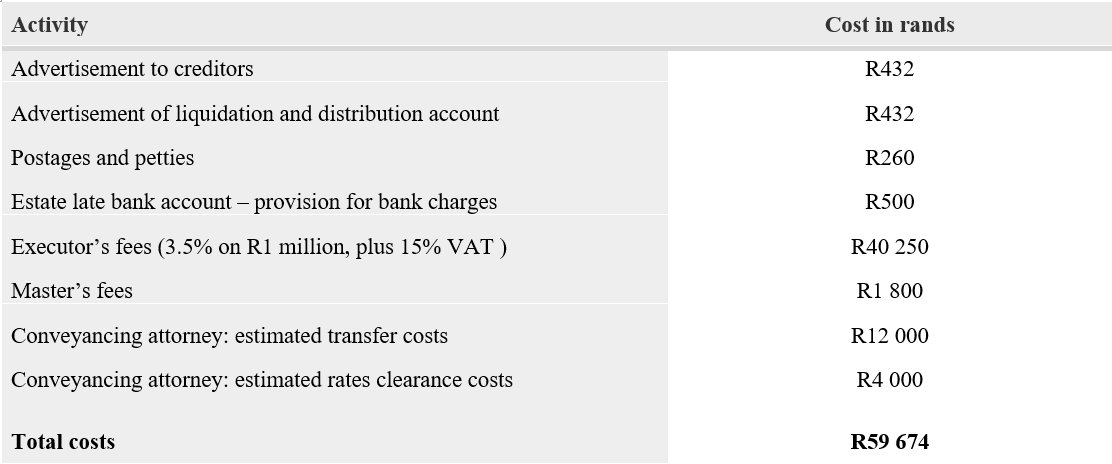
The size of an estate is likely to affect some of the costs, such as executor’s and master’s fees (though the latter is capped at R7,000), as well as conveyancing costs.
“It is also worth remembering that an estate is liable for income tax assessment until the date of death and depending on the assets and liabilities in the estate, these may attract estate duty and capital gains tax as well.”
The best way to avoid unforeseen negative consequences for loved ones is by way of thorough estate planning with a Professional Estate Planner.
“Completing an estate or financial plan with Bizfin – Trust & Estate Administration is the best way of ensuring that your loved ones will be left cared for and receive all the assets you intend for them to have, without having to sacrifice your home, means of transport or future income streams to cover your liabilities,”
Last Will and Testament.
“When last did you check and update your Will?” As circumstances change, you need to ensure that your Will complies with your wishes for when you pass on. It is frightening how many people do not have a Will, or even have one that has not been signed. An unsigned Will is as bad as no Will, and leaves major problems for those left behind.